Finding home far from home
It’s a sunny morning in Montreal. It snowed yesterday night for the first time this winter. My first snow in Montreal feels kind of exciting. Feeling like a kid, from the window I can see some snow in the gardens and on the railway. Everything is covered in snow. It feels so much like Christmas today. This is one of those mornings, crispy air when you just want to go in search of some good food books, the ones that you can find on your nonna’s shelves. When I was young I used to read them on Sunday mornings, approaching Christmas time, so I could be prepared for our favourite time of the year, cooking with mamma and nonna, scrambling in the kitchen for hours, baking cookies and my favourite crostata di mele. I can still remember the creased and stained pages of the “Il Libro Della Vera Cucina Fiorentina”, by Paolo Petroni. All my nonna’s and mamma’s recipes come from there. So I try to feel at home looking for some good Italian recipe books. I always travel with a recipe book. And I am lucky enough that I have my favourite one with me. I still don’t have a couch in my new apartment but my Italian soul knows the importance of instantly getting home with a recipe book.
I moved to Montreal a few months ago, not properly prepared for the long and cold winter ahead. Luckily, October and November have been very good to me, treating Montrealers with a beautiful and mild Autumn, so that I got to know every corner of my neighbourhood, strolling down the canal on the sunny weekends. I found my favourite spots already, the ones that make me feel at home. There’s a corner boulangerie where I go to enjoy the special smell of right-out-of-the-oven bread.
Smells are what can bring memories back and make you travel in time. It’s a beautiful exercise we all can do to reconnect to what we deeply enjoyed as kids. I think I know what I want today, the smell of bread revived something, and my kind of Sunday gets immediately clearer.
“Is this time for some focaccia? Yes, it surely is.”
Italians have rituals, some of those are even kind of sacrosanct I would say. Mine is focaccia on Sunday, and that’s the kind of food I always look for.
As Italians, our DNA functions on the recurrent feeling to find a place that feels like home, therefore in a blink of an eye I don’t even know how, I happen to gravitate here, to Mano Cornuto.
Mano Cornuto is a tiny, delicious restaurant in Montreal, at the corner between Rue Anne and Rue Ottawa, named Snack Bar Italien on their website. A big red M guides me through the entrance. It might have been what attracted me from the far end of the road in the first place. If you walk by, you end up right in front of their one-stop-shop Mano Figa and, to be honest, this immediately caught my attention, and I thought “there must be some Italians here – or at least someone who has authentic knowledge of Italian slang.”
Today is probably the 4th time in 2 weeks I’m visiting Mano Cornuto. It has kind of become my bar, as we would say in Italian, the one you go to when you’re done with work and you want to sit and read some newspaper, relax, or just enjoy a coffee in that atmosphere you feel at home, the smells I was talking about.
I’m sitting here sipping my macchiato. A long counter, where at the far end of one side you see the open kitchen and on the opposite side the coffee machine, with Italian posters on the wall, the mirror behind the counter reads Caffè Mano Cornuto, Insalate, Pasta, Formaggi, Focacce, Salumi e Dolci. On the shelves, are several food-related books.
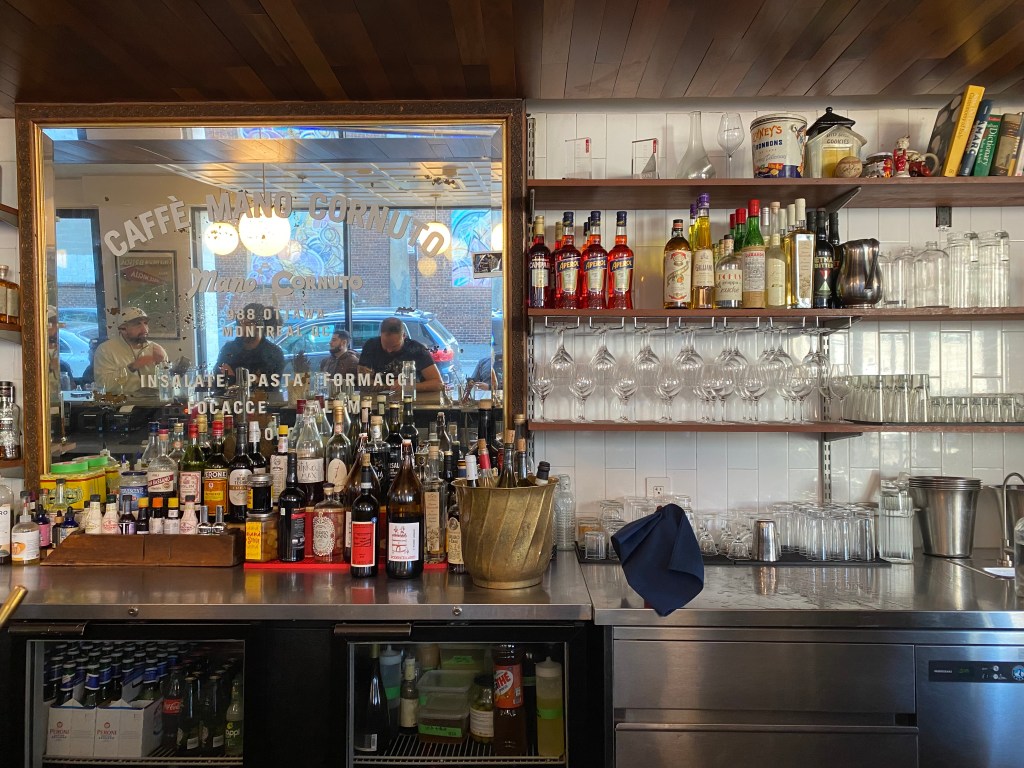
I try to read the titles and, close to the Amaro one, I see something that catches the eye of an Italian in search of Italy, Gastronomy of Italy by Anna Del Conte. I take a moment to enjoy and acknowledge that this is the vibe I spontaneously gravitate to, the chefs cooking in the open kitchen, “you make me feel like dancing” playing in the background is making them all dance. I am not sure if it’s the music, the taste of coffee, the finally found Gastronomy of Italy, or the smell of simmering liver in the boiling pan, but I feel like part of a cooking scene with le donne di casa, mamma nonna e zie, getting ready and cooking food for some Sundays with family. I am back in my nonna’s kitchen, it’s an instant, a magical sensation.
“Le Petite Pain Au Chocolate” starts playing, stretching memory muscles to 1968, to the Italian version called “Luglio col bene che ti voglio”, flashback again to teenage summers in pineta, singing these songs and looking for pinoli. Oh Pinoli! I rub my fingers to make sure I don’t have resin between them.
This is my little Italian corner, feeling home away from home.
It’s a necessity for Italians abroad to find a place that feels like home. It’s the place where we go to watch la partita while feeling comforted and closer to your home town. And what makes these places so special, it’s first and foremost their people. Just like Vito Coccia, one of the owners of Mano Cornuto. Vito explains the concept behind Mano Cornuto, an edginess that sets it apart, “I knew I had to call the place somehow. It’s a long story; I am in Messico on the beach while my phone rings. The place I’ve been looking to rent for so long is up in the market again and the owner is calling to see if I am still interested. What a sign of destiny! I have my mano cornuta and my cornicello on my neck and I moved them to get out of my hair and, hold on a minute, yes of course, ‘Mano Cornuto’, caffe’ Mano Cornuto. This is how everything started.
I called my mum and she was like, “Vito, you can’t call it that way”. But today she tells me all the time, that the name protects me, that’s where I get my luck from. He wears mano cornuto, cornicello, like he can’t ever take it off. From the Sicilian side he got the mano cornuto and the cornicello for Baptism. The Sicilian part of his family is very superstitious. When he would go for a walk with his nonna, she would say “fai i corna”, and he would ask why and she’d reply “because you have to do i corna to protect yourself. And when someone pisses you off you send i corna”. I smile, and we keep on our conversation.
On the marketing side, the two servers on the windows are both giving the corna to each other. This comes directly from his childhood, when he used to read comics, there were spies fighting each other. The Italian version spia contro spia, the 2 servers are now part of his unique brand.
As I keep asking him questions, I discover some of the most interesting aspects of him being Italian, which amazes me the most. “The roots and the background I have are instilled in my life. Any immigrant should be blessed to have that.” We had a little conversation about al dente, and he told me he likes his cavatelli cotti, and so I ask if he cracks his spaghetti. He looks at me and says “no, io no e tu si?” Then he continues and says “gli ziti si”. When I ask what kind of pasta that is, it is blatantly when I have my second lesson of the day. I swear, I would have never thought to learn what the ziti was in Montreal. This is why Italians and Italy are so rare all over the world. This is something that you can hardly explain and that anyone can hardly understand the value tied to it. He told me that ziti is a special type of pasta that you would eat for Christmas.
Grazie Vito, I think I am going to look for ziti today, as I may feel homesick for Christmas far from home. I’ll promise to crack them because as you said: gli ziti li devi spaccare.
There is something else I ask him before leaving Mano Cornuto. “Quanto vuoi bene alla nonna? – Troppo” he says, showing me some pictures of nonna. It is so beautiful and rare to still find these authentic feelings, sharing memories while showing me these pictures. “These things to me are important”, this basket of pears, I have it in the back, I put my fruits in there, I try to bring all my family here, this is the most important thing. There’s a bit of silence between us, it might be because these are the kind of conversations that can make you emotional especially if you live abroad. I keep looking at those pictures Vito is showing me thinking that Italians are so lucky to have this in their DNA, something that can’t be replaced.
“I feel Italian the most when I wake up and when I go to bed. I don’t even tell people I’m Canadian, I’m Italian living in Montreal. I was made by Italians. Having a restaurant or a cafe where my dad is semi-retired, and he comes and sits on a chair outside, drinking his coffee, and just sits there, saying hi to the customer coming in, knowing his son is working in the restaurant, it is just a beautiful thing, and my ultimate dream.”
Everything here exudes Italianness. The smell of peperoncino and garlic, the simmering sugo in the pot, this has the natural and special power to throw me into some pictures of heavy-duty Italian cooking.
Mano Cornuto is one of my favourite spots in the neighbourhood so far. I tend to go in the morning before lunch, I really do love my macchiato sitting at the counter, watching outside of the windows people passing by. I go there in the evening for some spritz or again on Saturday, for my favourite date with pasta. This is a serious thing for Italians I tell you.
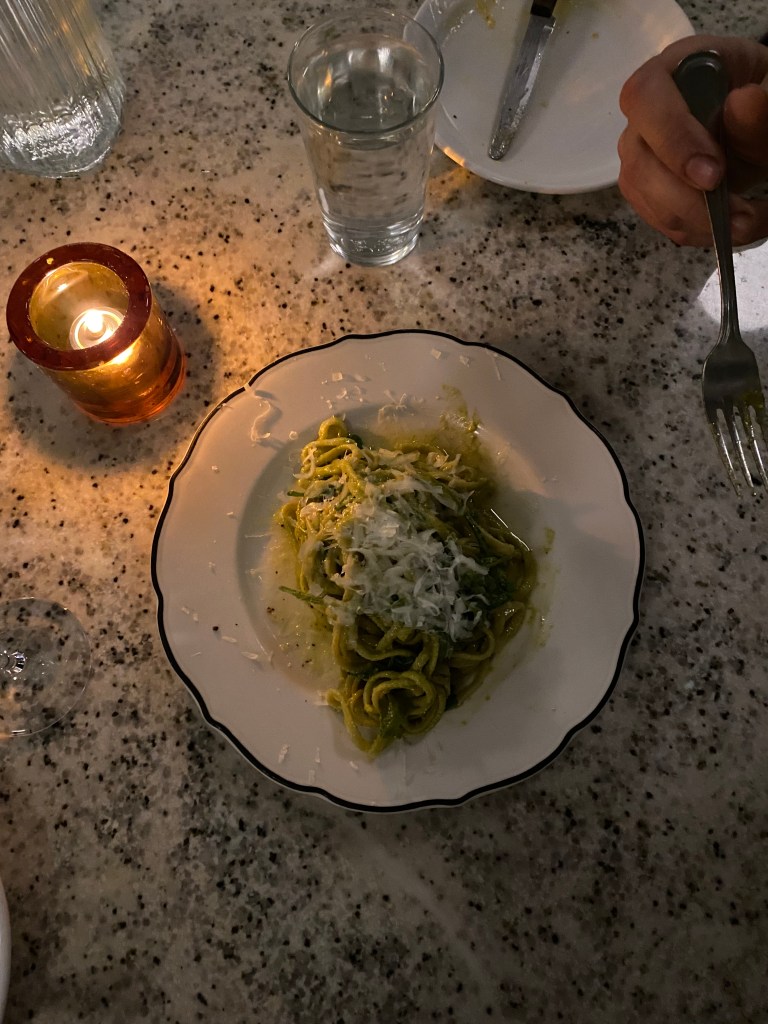
Mille miglia posters on the wall and my Sunday focaccia that, no matter where it brings me back home. We’re taking it seriously and they are too. “Vito ma tu la fai la scarpetta? – Ma sicuro, this is why we have focaccia. So then I say, “okay, you are Italian, if you do la scarpetta you are Authentically Italian.”
 Giulia's Column